What is HND in Cameroon?
In Cameroon, the Higher National Diploma (HND) is a nationally‐accredited, vocational higher‐education diploma. It is awarded by the Ministry of Higher Education after two years of post-secondary study beyond the Baccalaureate or GCE A-Level. In practice, HND programs are career-focused and taught in institutes (like Buea Iinstitute of Technology) that stress practical skills. The BIT site notes that the HND is “equivalent to the first two years of a bachelor’s degree in Cameroon and the UK”. In other words, a student who completes an HND has effectively finished the academic equivalent of the first two years of university study.
Higher National Diploma programs in Cameroon are delivered in classroom and lab settings, emphasizing hands-on skills. These programs aim to “teach the knowledge and skills you will need for employment,” with a strong focus on learning by doing. In short, the HND is a two‐year professional diploma (Bac+2) designed for careers in industry.
What is the meaning of HND?
The acronym HND stands for Higher National Diploma. It is a vocational higher‐education qualification originally developed in the UK, and now offered in many countries (including Cameroon). In Cameroon’s education system, the HND literally means a diploma above the National Diploma (ND) level. Graduates of an HND have more advanced training than ND holders but do not hold a full bachelor’s degree. Bit’s curriculum emphasizes that HND graduates gain “industry-specific skills and knowledge” through practical training. In effect, earning an HND certifies that a student has completed a specialized, hands-on program of study after secondary school.
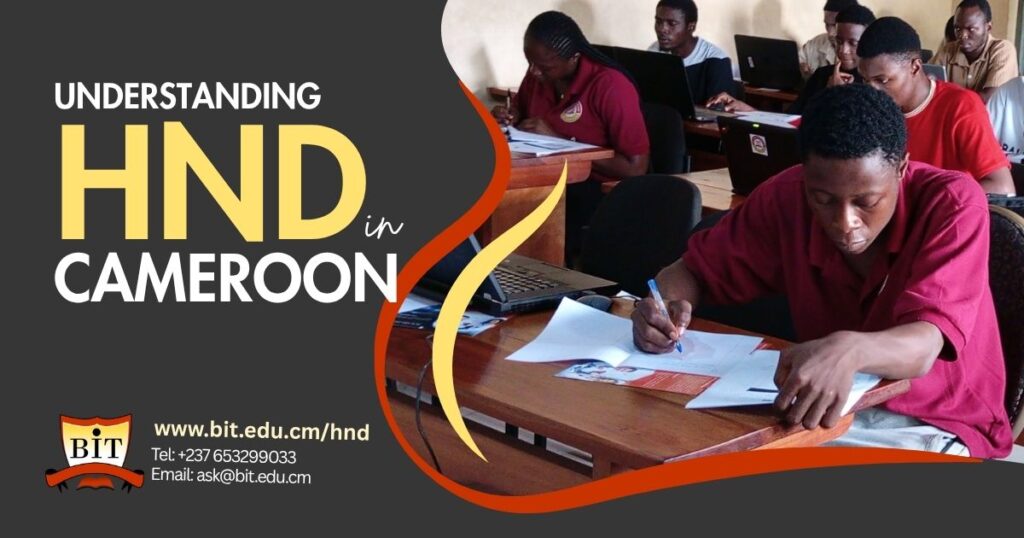
The HND program emphasizes practical, hands-on learning. (The photo above shows a student working on real computing projects.) In an HND course, students spend much of their time on labs, projects or internships. BIT highlights that HND curricula include work placements and real-world case studies, so that “graduates [have] hands-on experience and industry-specific expertise”. In short, the “higher national” diploma is built around applied skills and vocational training, rather than purely academic coursework.
Can I do a master’s with an HND?
Not directly. In Cameroon (as in most systems), entry to a Master’s degree normally requires a full bachelor’s degree. An HND by itself is below the level of a bachelor’s degree. However, Higher National Diploma graduates often have options to advance their education. For example, many universities will admit HND holders into the final year of a related bachelor’s program. In practice, a student can complete an HND (2 years), then do an extra year to top up to a full B.Sc. degree, and only then proceed to a master’s. BIT’s own literature confirms this pathway: “Graduates have the option to progress to the final year of a related bachelor’s degree programme”. In summary, you cannot leap straight to an M.Sc. after an HND – you would first need to upgrade to a bachelor’s level through a top-up program or additional study.
How many years is an HND?
In Cameroon (as elsewhere), a Higher National Diploma is typically a two-year full-time program. BIT explicitly states that all its HND programmes last 2 years. This matches the standard definition: in the UK and many countries, an HND requires two years of study (about 4 semesters). (In some cases, an HND can be earned in one year after a Higher National Certificate (HNC), but in Cameroon it is normally 2 years post-Bac.) The two-year duration gives students enough time for classroom instruction plus practical projects.
Is HND a good qualification?
Yes, in the sense that it is very valuable for career‐oriented fields. Higher National Diploma programs are designed to make graduates job-ready. They teach practical skills that apply directly to specific industries, so employers often prize HND holders in technical roles. For instance, engineering, IT, media, hospitality and management sectors actively recruit Higher National Diploma graduates because of their hands-on experience. HNDs also offer a bridge to higher education: many universities give HND holders advanced standing, letting them skip into the final year of a degree program. Overall, the HND provides solid, career-relevant training. (That said, it is not a substitute for a full bachelor’s if you need that qualification later, but it is indeed a good professional credential.)
Key features of the HND include:
- Practical, Career-Focused Curriculum: Courses stress hands-on learning and real projects. BIT notes that HND programmes emphasize work placements and industry projects, making graduates attractive to employers.
- Two-Year Program: The HND is a 2-year diploma (Bac+2), equivalent to the first two years of a university degree. This gives time for in-depth study of technical topics.
- Direct Career Path: Higher National Diploma graduates often enter the workforce immediately or continue to a bachelor’s top-up. Employers recognize HNDs and in many fields the diploma greatly improves employability.
Is HND higher than a bachelor’s degree?
No. An HND is not higher than a bachelor’s; it is actually below that level. As noted, an HND corresponds to roughly the first two years of a bachelor’s degree. In academic terms, a bachelor’s degree is a higher qualification. In Cameroon, you cannot substitute an HND for a full B.Sc. or B.A. when a job or graduate program specifically requires a bachelor’s. The HND’s strength is in vocational skills, not in being a higher diploma.
HND Courses at Buea Institute of Technology (BIT)
Buea Institute of Technology (BIT) in Buea is one of Cameroon’s leading institutes offering HND programs. Founded in 2014 as a specialist IT and media training centre, BIT provides diploma and degree courses focused on modern technology and creative media. In particular, BIT advertises a range of Higher National Diploma programmes in applied fields, including:
- HND Software Engineering
- HND Computer Graphics & Web Design
- HND Journalism
- HND E-Commerce & Digital Marketing
- HND Graphic Design
- HND Cinematography
Each of these HND programs at BIT is a two-year course. BIT emphasizes that students get hands-on training (e.g. coding, design, or production projects) and that its graduates emerge with industry-relevant skills.
For prospective students in Buea and beyond, BIT offers full admissions support. Contact details are:
- Address: P.O. Box 1530 Molyko, Buea, South West Region, Cameroon.
- Telephone: +237 653 299 033.
- Email: ask@bit.edu.cm.
Applications are accepted from June to October, and BIT’s admissions office can guide you on entry requirements and registration.