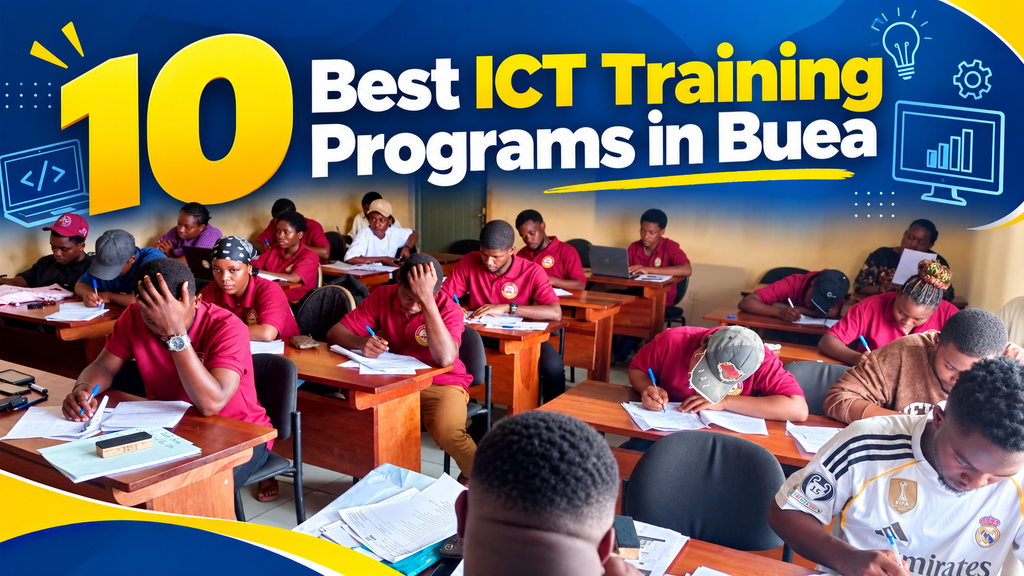
Looking for the best ICT training programs in Buea? Discover the skills that can help you build a career, start a business, freelance online or become more competitive in Cameroon’s growing digital economy.
Technology is changing the way we work, communicate, learn and do business. From software development and cybersecurity to digital marketing, graphic design and web development, ICT skills are becoming increasingly valuable for students, graduates, entrepreneurs and working professionals.
For students in Buea, the challenge is no longer simply finding a computer training centre. The bigger question is:
Which ICT skill should you learn, and which programme can give you the practical skills you need to turn that knowledge into a career?
Buea has developed into an important educational and technology hub in Cameroon, with universities, vocational training institutions, technology companies, startups and digital businesses creating opportunities for people with practical ICT skills.
Among the institutions providing specialised ICT and media training is Buea Institute of Technology (BIT), a vocational training institute offering short courses, certificate programmes, National Diploma and Higher National Diploma programmes in ICT and media-related fields.
Whether you are a secondary school graduate looking for a career path, a university student who wants additional practical skills, or a professional seeking to upgrade your digital abilities, here are 10 ICT training areas worth considering in Buea.
Your top 10 ICT Training Programs in Buea
1. Software Engineering
Build software. Solve problems. Create the future.
Software engineering is one of the most versatile ICT career paths for students who enjoy technology, logical thinking and problem-solving.
Software engineers design, develop, test and maintain applications and software systems used by businesses, governments, schools and individuals.
A serious software engineering programme should go beyond teaching programming syntax. Students need to understand how software is planned, designed, developed, tested, deployed and maintained.
What can you learn?
Depending on the programme, students may study:
- Programming
- Algorithms and problem-solving
- Database systems
- Web development
- Software engineering principles
- Application development
- System analysis and design
- Testing and debugging
- Version control
- Software project development
Career opportunities
Software engineering can lead to careers such as:
- Software Developer
- Web Developer
- Applications Developer
- Backend Developer
- Frontend Developer
- Full-Stack Developer
- Systems Analyst
- Junior Software Engineer
At BIT, the HND Software Engineering programme is designed around software development, with an emphasis on practical and industry-relevant skills. BIT also offers an ND in Applications Development for students seeking a more focused diploma-level pathway into application development.
If you want to build the technology rather than simply use it, software engineering is a pathway worth exploring.
2. Web Design and Web Development
Turn ideas into websites and digital experiences.
Almost every modern organisation needs a website.
Businesses, schools, NGOs, churches, government agencies, entrepreneurs and professionals all depend on websites to communicate with customers and audiences.
Web design and development therefore provide practical skills that can be used for employment, freelancing or entrepreneurship.
Students can learn areas such as:
- HTML
- CSS
- JavaScript
- Responsive web design
- WordPress
- Website development
- User interface design
- Web hosting
- Domains and DNS
- Website security
- Search engine optimisation
Web development can also be an excellent starting point for freelancing because students can begin building websites for small businesses, organisations and individuals while developing their portfolios.
At BIT, students can choose different levels of web and software development training, including a Certificate in Web Design, ND Webmaster, ND Applications Development and HND Software Engineering.
You don’t need to wait for a company to give you your first opportunity. Learn to build websites and start creating opportunities for yourself.
3. Computer Graphics and Web Design
Design it. Build it. Bring digital ideas to life.
Modern digital careers increasingly sit at the intersection of creativity and technology.
If you enjoy both design and computers, computer graphics and web design can provide a powerful combination of skills.
This field brings together visual communication, graphic design, animation and web development.
Students may develop skills in:
- Graphic design
- Web design
- Typography
- Image editing
- Digital illustration
- UI/UX concepts
- Animation
- Multimedia
- Adobe creative tools
- Website development
- Digital content production
BIT’s HND Computer Graphics and Web Design is a two-year programme combining creative and technical skills. Career opportunities can include graphic designer, web developer, multimedia artist, UI/UX designer and digital marketer.
For students who want a career where technology meets creativity, this can be an exciting pathway.
4. Digital Marketing and E-Commerce
Build brands. Reach audiences. Drive growth.
You don’t have to become a programmer to build a career in technology.
Digital marketing has created opportunities for people with interests in communication, business, creativity, analytics and entrepreneurship.
Businesses increasingly need professionals who understand how to attract customers online, create content, manage social media, optimise websites and run digital advertising campaigns.
Important areas include:
- Social media marketing
- Search Engine Optimisation (SEO)
- Online advertising
- Content marketing
- Email marketing
- E-commerce
- Website management
- Digital analytics
- Online customer acquisition
- Electronic payment systems
BIT’s HND E-Commerce & Digital Marketing covers areas including website development, SEO, social media marketing, data analytics and online advertising.
For people looking for a shorter pathway, BIT also offers a Certificate in Digital Marketing, covering WordPress, digital marketing and e-commerce, search advertising, social media marketing, SEO, electronic payment systems, email and affiliate marketing, and graphic and multimedia design.
If you want to help businesses grow online—or build your own online business—digital marketing is a skill worth investing in.
5. Graphic Design
Create visuals. Build brands. Communicate ideas.
Every business needs visual communication.
Logos, posters, social media graphics, brochures, advertisements, packaging and other digital assets are created by graphic designers.
Graphic design can therefore be particularly useful for students who are naturally creative and want to turn their creativity into a professional skill.
Training can cover:
- Design principles
- Typography
- Colour theory
- Branding
- Layout design
- Image manipulation
- Advertising design
- Social media graphics
- Print design
- Digital illustration
BIT’s ND Graphic Design focuses on design principles, typography, image manipulation, branding and layout composition using industry-standard software.
Graphic design can also complement other ICT skills. For example, a web developer who understands graphic design can communicate better with clients and create more complete digital experiences.
6. Cybersecurity
Protect systems. Defend data. Build digital trust.
As more businesses and individuals move their activities online, protecting information and digital systems becomes increasingly important.
Cybersecurity covers the technologies, practices and processes used to protect computers, networks, applications and data from threats.
Students interested in this area can explore:
- Cybersecurity fundamentals
- Network security
- Cyber threats
- Password and account security
- Data protection
- Security awareness
- System vulnerabilities
- Incident response
- Basic security tools
- Cybersecurity best practices
BIT offers the Cisco Certified Support Technician (CCST) Cybersecurity programme, developed by Cisco to provide foundational cybersecurity knowledge and practical skills for people beginning a cybersecurity career.
If you are fascinated by how cyber attacks happen—and how systems can be protected—cybersecurity could be your technology pathway.
7. Computer Networking
Connect people. Connect systems. Keep organisations running.
Behind every successful digital organisation is a network.
Computers, servers, smartphones, printers, cloud services and other devices need to communicate with each other.
Computer networking training introduces students to the technologies and concepts that make this communication possible.
Training may cover:
- Computer networks
- LAN and WAN
- Network devices
- IP addressing
- Routing
- Switching
- Wireless networking
- Network troubleshooting
- Network security
- Internet technologies
Networking skills can be particularly valuable for people who want to work in IT support, network administration, telecommunications or infrastructure management.
BIT includes ND Computer Networking among its National Diploma programmes. Its ND programmes are designed as hands-on programmes and include coursework followed by an internship placement.
8. Computer Maintenance and IT Support
Learn how technology works—and how to keep it working.
Not every ICT career involves writing software.
Organisations need technicians who can install, configure, troubleshoot and maintain computer systems and related equipment.
Computer maintenance training can introduce students to:
- Computer hardware
- Operating systems
- Hardware installation
- Software installation
- Troubleshooting
- Preventive maintenance
- Computer security
- Peripheral devices
- Basic networking
- Technical support
These skills can be useful for employment in schools, businesses, government offices, ICT companies and other organisations.
They can also provide a foundation for entrepreneurship, allowing trained technicians to offer computer repair and IT support services.
BIT offers an ND in Computer Maintenance as part of its National Diploma programme portfolio.
9. Digital Media, Video Production and Cinematography
Tell stories. Create content. Capture attention.
The digital economy is not powered by software alone.
Video has become one of the most important forms of communication on websites, social media platforms, television, advertising campaigns and online learning platforms.
Students interested in visual storytelling can explore:
- Video production
- Camera operation
- Video editing
- Cinematography
- Lighting
- Sound
- Storytelling
- Motion graphics
- Documentary production
- Social media video
BIT offers programmes in Cinematography, Media Photography and Audiovisual production, alongside other media-focused programmes.
These skills can open pathways into film production, television, advertising, social media content creation, corporate communications and freelance media production.
If you have a story to tell, learn the technology needed to tell it professionally.
10. Digital Photography and Multimedia
Turn creativity into a professional digital skill.
Photography has evolved far beyond traditional studio work.
Today, photographers create content for websites, social media, businesses, advertising campaigns, events, publications and digital platforms.
Digital photography training can help students develop skills in:
- Camera operation
- Composition
- Lighting
- Photo editing
- Digital image management
- Portrait photography
- Event photography
- Product photography
- Commercial photography
- Multimedia production
These skills can also complement graphic design, digital marketing, video production and entrepreneurship.
A photographer who understands digital marketing, for example, can build a stronger personal brand and attract clients online.
Which ICT Programme Should You Choose?
The right programme depends largely on what you want to do with technology.
| If you want to… | Consider studying… |
|---|---|
| Build software and applications | Software Engineering |
| Build websites | Web Design / Webmaster / Applications Development |
| Combine design and technology | Computer Graphics & Web Design |
| Help businesses grow online | Digital Marketing & E-Commerce |
| Create visual identities and designs | Graphic Design |
| Protect systems and information | Cybersecurity |
| Build and manage computer networks | Computer Networking |
| Repair and maintain computers | Computer Maintenance |
| Produce professional video | Cinematography / Video Production |
| Create professional photographs | Digital Photography |
The important thing is not simply to choose a programme because it is popular. Choose a field that matches your interests, abilities and long-term career goals.
Why Practical ICT Training Matters
A certificate alone does not automatically make someone employable.
The technology industry rewards people who can do things.
- Can you build a website?
- Can you develop an application?
- Can you design a professional brand?
- Can you run a digital marketing campaign?
- Can you troubleshoot a computer?
- Can you configure a network?
- Can you edit a professional video?
- Can you secure a digital system?
These are the kinds of practical questions students should ask when selecting an ICT programme.
At Buea Institute of Technology, practical learning is central to the institution’s approach. BIT describes itself as a vocational and career-focused school offering short courses, certificates, National Diplomas and Higher National Diplomas in ICT and media-related fields.
Its ND programmes are designed as hands-on programmes and include an internship component, while its HND programmes emphasise practical, industry-specific learning.
Why Study ICT at Buea Institute of Technology?
Choosing where to study can be just as important as choosing what to study.
At Buea Institute of Technology, students can build their education around different levels of training depending on their qualifications, career objectives and available study time.
Short Courses and Certificate Programmes
These are suitable for people who want to acquire specific practical skills within a shorter period.
BIT offers certificate-level training in areas such as:
- Basic Computing
- Graphic Design
- Web Design
- Digital Photography
- Videography
- Digital Marketing
BIT states that its certificate programmes can generally be completed within approximately four to six months.
National Diploma Programmes
BIT’s National Diploma programmes provide a longer and more structured pathway for students seeking vocational qualifications.
Programmes include:
- ND Applications Development
- ND Webmaster
- ND Computer Networking
- ND Computer Maintenance
- ND Production of Graphic Design
- ND Office Automation & Secretaryship
BIT states that its ND programmes are 10-month hands-on programmes incorporating coursework and internship placement.
Higher National Diploma Programmes
For students looking for a more advanced two-year vocational qualification, BIT offers HND programmes including:
- HND Software Engineering
- HND Computer Graphics & Web Design
- HND Graphic Design
- HND E-Commerce & Digital Marketing
- HND Journalism
- HND Corporate Communication
- HND Cinematography
- HND Media Photography & Audiovisual
Your ICT Career Can Start in Buea
The digital economy is creating opportunities for people who can combine technical knowledge, creativity and practical problem-solving.
You don’t necessarily have to leave Cameroon to begin developing valuable technology skills.
You can start in Buea.
You can learn a skill.
You can build projects.
You can create a portfolio.
You can take on internships.
You can freelance.
You can start a digital business.
And, with the right skills and determination, you can build a career that reaches far beyond Buea.
Ready to Start Your ICT Journey?
Maybe you have just completed secondary school and are wondering what to study next.
Maybe you are a university graduate who wants practical skills.
Maybe you are already employed but want to move into technology.
Maybe you want to become a software developer, designer, digital marketer, network technician, cybersecurity professional or content creator.
Your starting point does not have to determine your destination.
What matters is choosing the right skill, learning it seriously and putting it into practice.
At Buea Institute of Technology, you can choose from a range of practical ICT and media programmes designed for different career paths and levels of study.
Build the skills. Create the projects. Start your career.
Explore BIT’s ICT programmes and find the pathway that matches your ambitions.
Admissions for the October 2026 session are currently open.
Apply to Buea Institute of Technology today and take the first step towards your technology career.
Buea Institute of Technology (BIT)
P.O. Box 1530, Molyko, Buea, Cameroon
Tel: +237 653 299 033 / +237 674 878 693
Email: ask@bit.edu.cm
Your Tech Career Begins at BIT.